Table notes
Restaurant armchairs versus side chairs at the same table
Late in a long dinner, a guest does one of two things with a chair. Some turn in it, a shoulder to the table, to talk to the person beside them. Others settle back and rest their forearms along the arms.
Side chairs suit the first habit and armchairs the second, and a dining room seats both kinds of guest every night. The choice isn't comfort against price alone. Arms take width, and a table edge hands out width in fixed amounts. This guide counts it.

Open diagram at full size (new tab) ↗
Read the diagram in text
Three cards give the width arms add, 2 to 5 1/2 inches, the 24 inches of table edge each diner gets, and the 10 to 12 inches between seat and tabletop. A side panel counts a 30 by 72 table: three chairs a side at 24 inches, four side chairs or three armchairs at 18, and an armchair at each head.
- CHAIR NOTES
- Width the arms add: 2 to 5 1/2 inches across four chair pairs.
- Edge per diner: 24 inches, or 18 on the tightest night.
- Seat to tabletop: 10 to 12 inches. The arm has to stay under it.
- A 30 BY 72 TABLE
- At 24 inches: 3 a side
- At 18: 4 side chairs, 3 arm
- Heads: an armchair each
- Arms at the heads, armless chairs along the sides.
- Width the arms add, the edge each diner gets, and how many chairs one long side holds.
What arms add
Depth stays where it was. Width doesn't. Four pairs in our range show how much it moves:
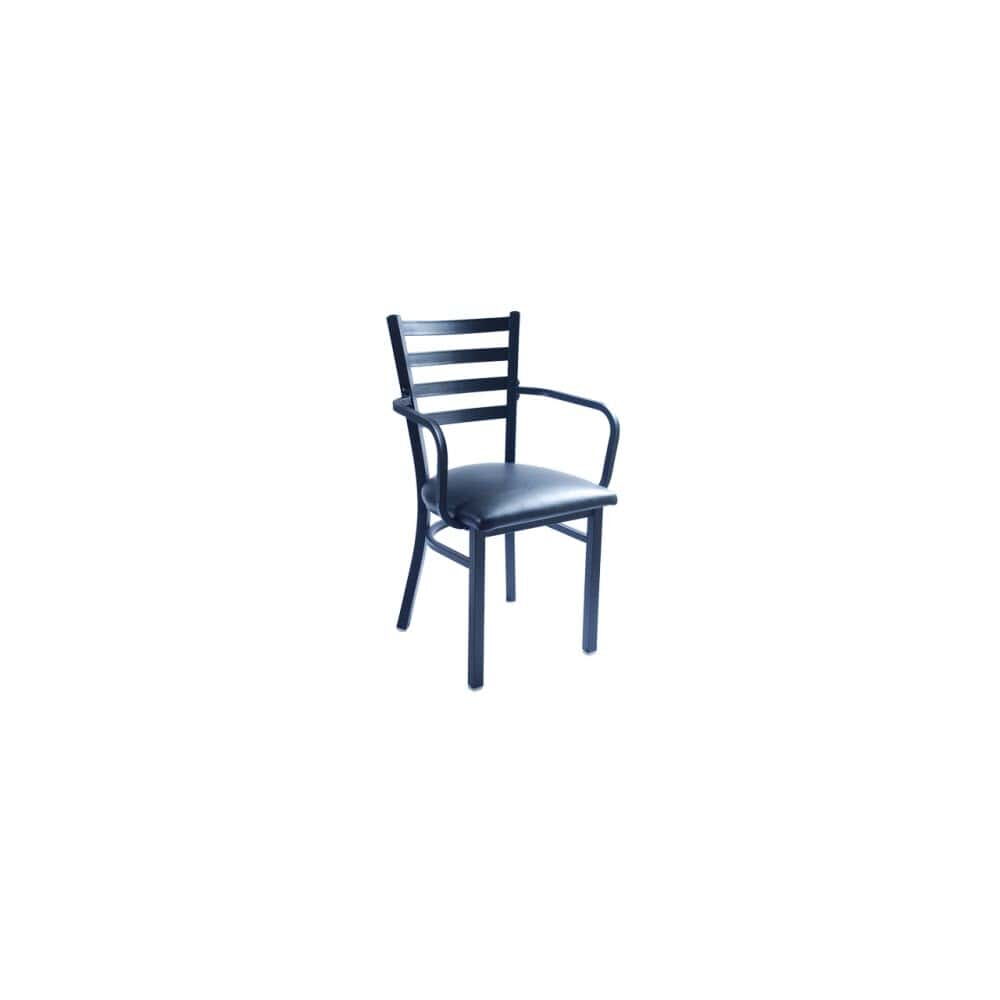
- A metal ladder-back chair with arms is 19 inches wide, against 17 for the same chair without them.
- A metal slat-back chair goes from 17 inches to 22.
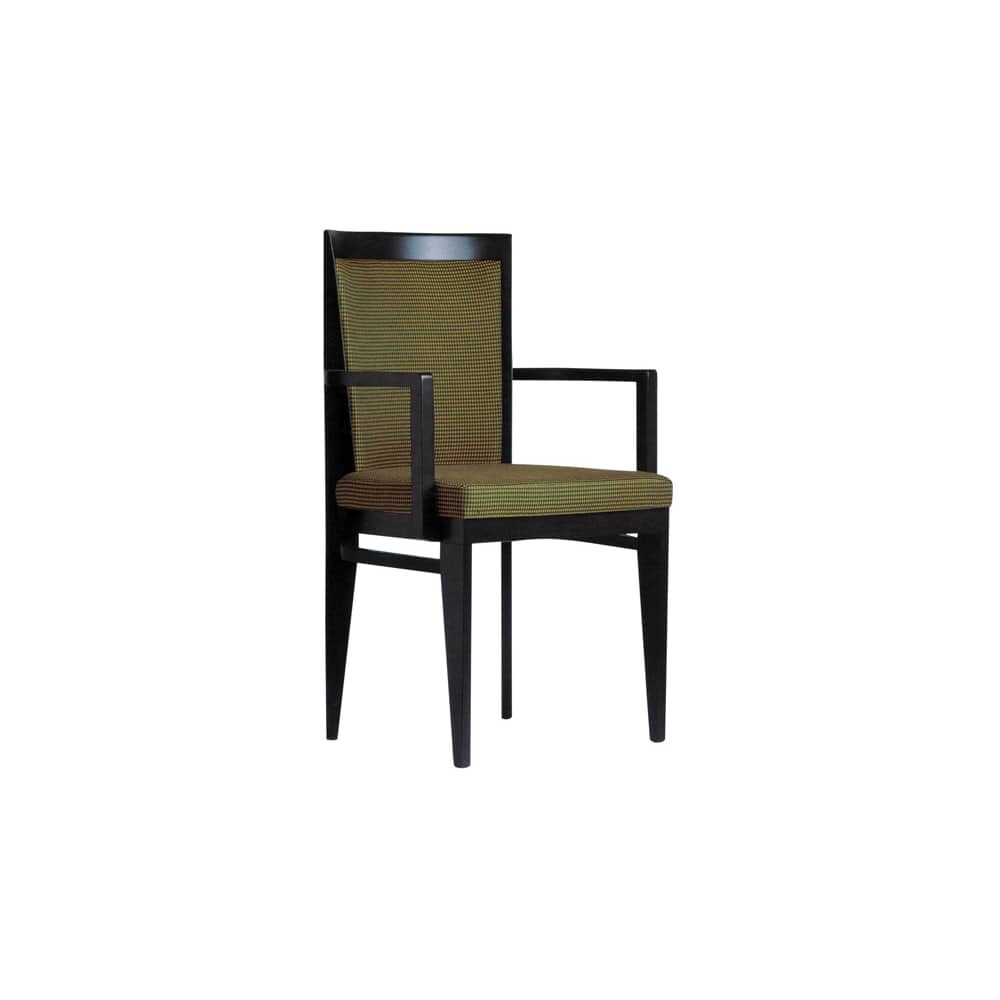
- A fully upholstered wood armchair is 22 inches wide, where its side chair is 18.
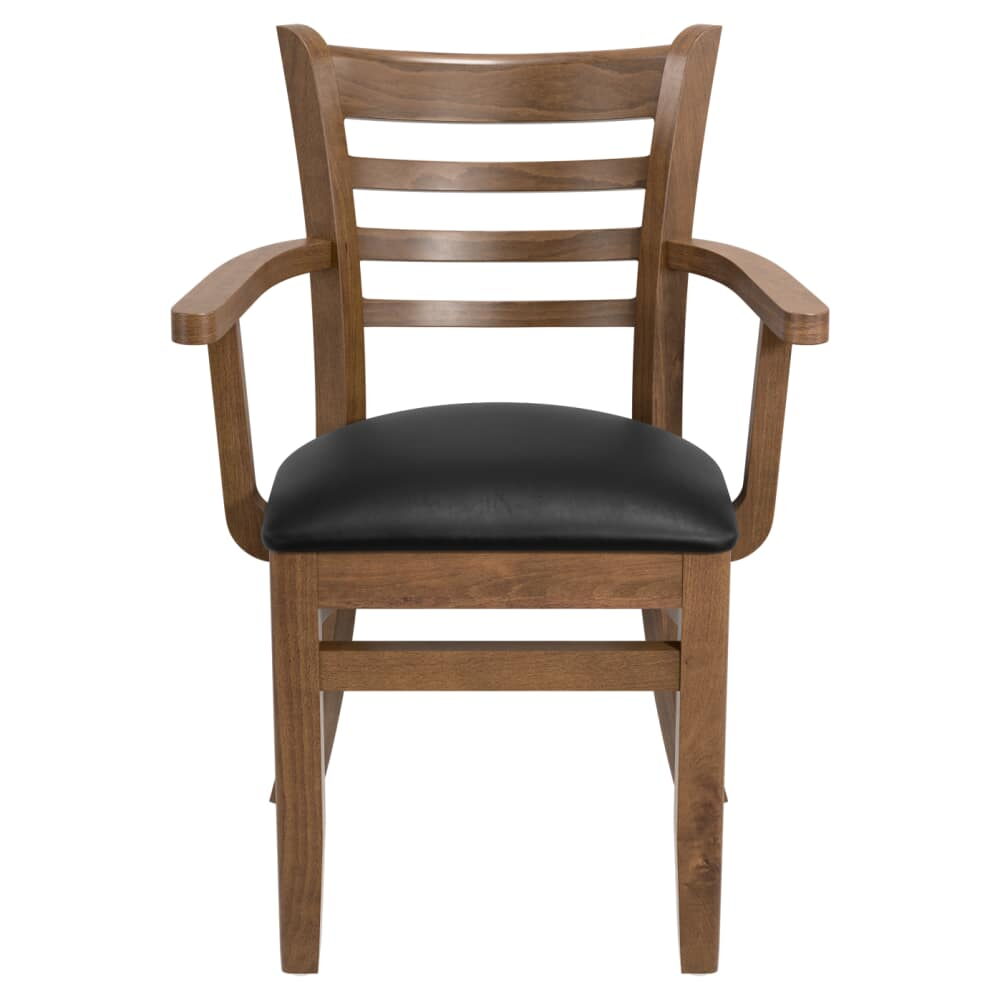
- The ladder-back wood armchair spans 22 1/2 inches where its side chair spans 17.
In each pair the depth is unchanged, at 20, 20, 22 and 20 inches, so a pulled-out chair claims the same strip of aisle. What changes is the room beside it: arms cost between 2 and 5 1/2 inches of width.
The table edge sets the count
A diner is allowed about 24 inches of table edge, and 18 on the tightest night. Take a folding wood banquet table in its 30 by 72 size, whose long side offers 72 inches. At 24 inches a diner it seats three to a side. Side chairs 17 inches wide use 51 of the 72 and leave 21 to spare. Wood armchairs at 22 1/2 use 67 1/2 and leave 4 1/2, so the arms of neighbors all but touch.
Then the room fills and the tight count takes over. At 18 inches a diner the same side holds four side chairs, 68 inches of seating in all, but only three armchairs, since a fourth would need 90. That is eight seats at one table against six. Across six such tables the gap is 12 seats, a whole party of twelve turned away.
Rounds forgive more. A 48-inch round, which seats five or six, has about 151 inches of edge, and six armchairs 22 1/2 wide take 135 of them. Chair backs fan outward as they leave the table, so arms find more room at the back than the front suggests. Squares and rectangles are where arms collide.
The ends of a rectangle are another matter. A 30 by 72 top is 30 inches across at each head, and an armchair 22 1/2 wide sits there with room to spare, its arms clear of every neighbor. Here is the rule of thumb to carry: arms at the heads, armless chairs along the sides.
Arms and the underside of the table
Seat height runs 17 to 19 inches and the top sits 10 to 12 inches above it. For a chair to tuck in, its arm has to stay below that line, less whatever an apron rail takes. When it doesn't, the arm stops against the table edge and the chair stays out in the aisle you counted at 36 inches.
A cast iron table base leaves the underside open, and an arm slides in. A table with a rail around its apron takes some of the gap. The mistake that spoils a room is buying armchairs for every seat and finding on delivery day that half of them won't tuck in. Test one chair at one table, or choose bases that leave the space.
Who sits where
Arms give a hand to the guest who is standing up. Side chairs give a shoulder to the guest who is turning. In the second hour of dinner, those two moves decide which chair people choose to stay in.
The open side of a booth table is where an armchair does best. A guest on the bench slides out; a guest on a chair has to push up, and an armchair with an aisle behind it and no neighbor beside it gives that push something to hold. Along a row of two-tops, where chairs get shuffled and pulled around, side chairs keep the room loose.
Arms also change what wears. The arm tops are the first place a hand lands, so on an upholstered chair the covering there goes first, and vinyl is the kinder choice for the fastest tables. Wood and metal arms wipe clean in a pass.
The comfort evaluation guide shows how to test the seat itself, and the inclusive fit guide looks at who needs arms and who needs the gap.
Price, weight and cover
Arms cost. The ladder-back wood chair starts at $106 and its armchair at $170, a difference of $64, so eight armchairs in place of eight side chairs add $512 at those starting prices. The upholstered wood pair is closer, $211 against $235. Both ladder-back listings show a 500-pound capacity and BIFMA certification, and the armchair weighs 26 pounds to the side chair's 22.
Cover follows construction. A metal chair that doesn't swivel carries a seven-year warranty, a selected wood side chair three, and a wood chair with arms one. Each product page gives its period when the listing makes it plain, and the warranty page sets out what each period covers. For a wood armchair, you trade length of cover for comfort, and for a metal one you may not trade at all.
Two lines on the order, one set of swatches
A line is one configuration, so side chairs and armchairs are separate lines even when they share a finish. Say a room has six 30 by 72 tables. The heads take 12 armchairs, and the sides take 36 side chairs, three to a side at 24 inches. That is 48 chairs on two lines, well past the order minimum of eight pieces, where tables and chairs count together.
Finish and upholstery lists change over time. Armchairs joining chairs that are already in service need a new swatch and a confirmed color before the order goes in, because the lists move over time; the same care applies to upholstery choices in general. Then save the counts to a seating plan, so the next person who reorders knows which chairs stand at the heads.